Arrival of the Normandy Train, Gare Saint-Lazare (1877)
A locomotive pulls into the great iron-and-glass train shed of the Gare Saint-Lazare in Paris, its steam rising into the roof. Monet painted twelve views of the station in early 1877 and showed seven of them at the third Impressionist exhibition that April. This version, Arrival of the Normandy Train, is in the Art Institute of Chicago; the best-known other version is in the Musée d'Orsay, Paris.
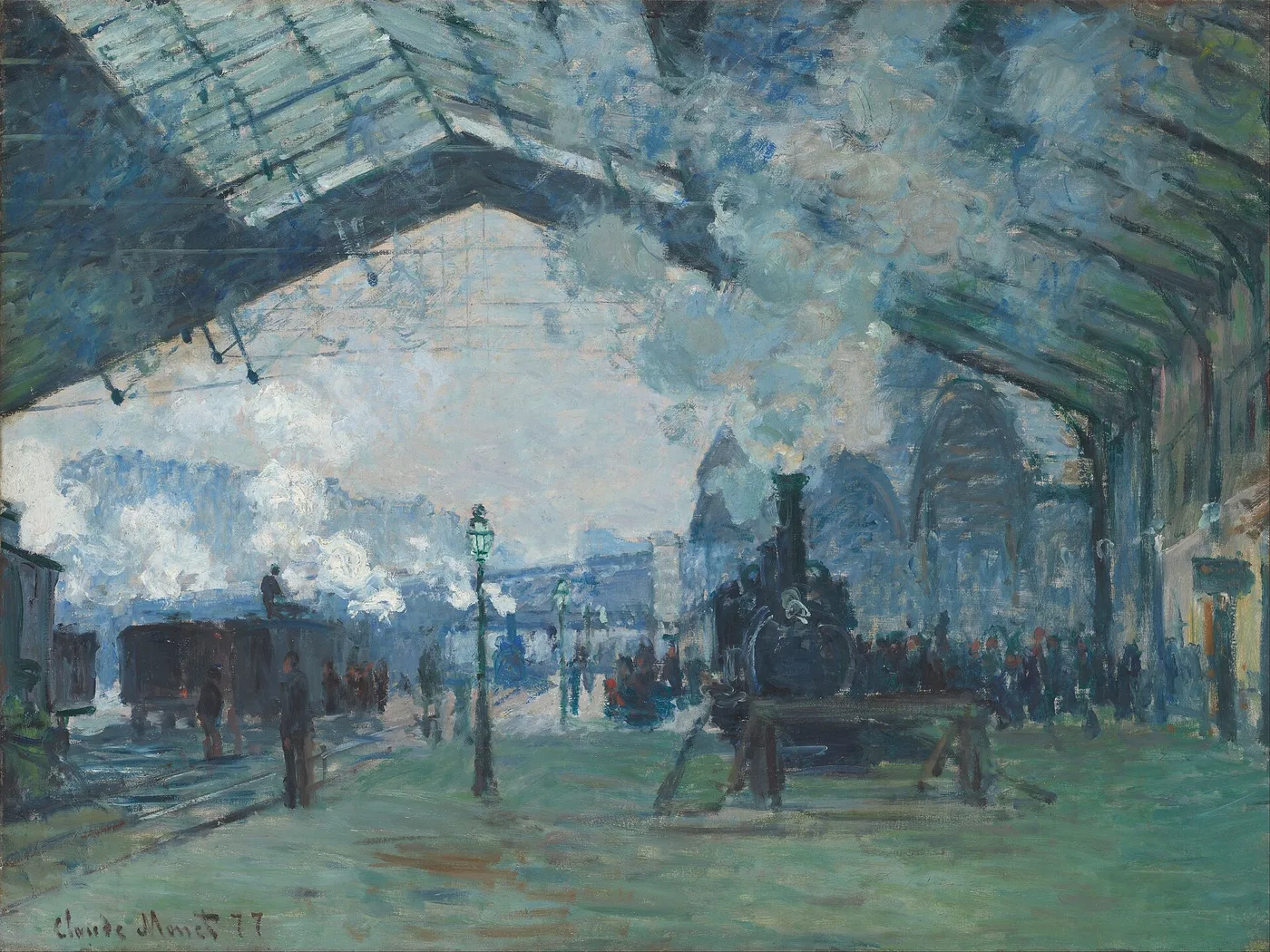
Image: Art Institute of Chicago, via Wikimedia Commons.
- Date
- 1877
- Medium
- Oil on canvas
- Dimensions
- 60.3 x 80.2 cm (23 3/4 x 31 1/2 in.)
- Collection
- The Art Institute of Chicago, Mr. and Mrs. Martin A. Ryerson Collection (1933.1158)
- Location
- Gare Saint-Lazare, Paris, the platforms of the Normandy line
- Signed
- Lower left: Claude Monet 77
- Series
- One of twelve known paintings of the Gare Saint-Lazare, 1877
- Also known as
- Gare Saint-Lazare; La Gare Saint-Lazare; Arrivée du train de Normandie, gare Saint-Lazare; The Gare Saint-Lazare series
What the painting shows
Monet stands inside the train shed, under the glazed roof, looking along the tracks where trains from Normandy pull in. A dark locomotive approaches at left, and a lamppost in the center lines up exactly with the peak of the glass canopy, splitting the composition in two. Through the open end of the shed we glimpse the arched bays of the parcel depot on the rue d'Amsterdam side of the station.
Most of the picture is given over to steam and smoke. Billows of bluish-gray and white fill the roof and drift across the iron framework, so that the solid structure seems to dissolve into vapor and daylight. People are present but barely individual: workers milling on the left and passengers waiting on the platforms are suggested with dark strokes and touches of reddish brown. As the Art Institute puts it, Monet was after the sensation of modern life in motion rather than any particular person.
How Monet came to paint the station
By the end of 1876 Monet had grown restless in Argenteuil, the suburb northwest of Paris where he had lived since 1871. With financial help from his friend, the painter and collector Gustave Caillebotte, he rented a ground-floor studio at 17, rue Moncey, a few blocks from the Gare Saint-Lazare. The station was the terminus of the line that served Argenteuil and Normandy, and it was then the largest and busiest in Paris.
In January 1877, having set up the studio, Monet asked for official permission to paint inside the station and seems to have started work as soon as the director of the Chemins de Fer de l'Ouest agreed. Because the noise and constant movement made painting difficult, he made pencil sketches in sketchbooks, which was unusual for him. Technical study at the Art Institute shows that he probably worked on this canvas both at the station and in the studio, adjusting the tracks and painting out an earlier version of the roof's iron grid with thick strokes of whitish-gray steam.
The Gare Saint-Lazare series
Monet painted twelve known views of the station in 1877, his first group of paintings devoted to a single motif. They vary in size, viewpoint and finish, from quick single-session sketches to larger, more worked canvases. The versions are now spread among several collections, including the Musée d'Orsay in Paris, the Fogg Art Museum at Harvard, the National Gallery in London, the Musée Marmottan Monet in Paris and the Art Institute of Chicago.
The best-known version is the Orsay's La Gare Saint-Lazare (about 75 x 105 cm), which shows the broad interior of the shed under its triangular roof, with the iron framework drawn more precisely than in Chicago. It came to the French state through the bequest of Gustave Caillebotte, who bought works from his friends and left his collection to the nation. The London picture is the closest to Chicago's in viewpoint and handling but was not shown in 1877. Repeating a motif to record changes of light and atmosphere became Monet's established method, leading later to the Stacks of Wheat, Rouen Cathedral and Water Lilies.
The 1877 Impressionist exhibition
Monet showed this painting at the third Impressionist exhibition, which opened in April 1877 in the rue Le Peletier, as Arrivée du train de Normandie, gare St-Lazare. The Art Institute's catalogue counts seven Saint-Lazare canvases identified as shown there, probably hung together; Caillebotte's large Le Pont de l'Europe, of the bridge over the same railway yard, was in the same exhibition.
The group was mostly well reviewed. Émile Zola praised Monet for capturing the energy of the station, the rumble of the trains and the torrents of smoke in the vast sheds, and one critic picked out the Chicago picture as excellent, an accurate and clear impressionism. Of the canvases shown it was not the largest or most finished, but it carries the most specific title, naming both the line and the direction of travel. The station pictures also mark an ending: they were Monet's last sustained attempt at city life, and from then on he turned almost entirely to landscape.
From Paris to Chicago
The painting sold quickly. In March 1877, before the exhibition, Monet sold it to the department-store owner and collector Ernest Hoschedé, one of his main patrons at the time. By 1878 it belonged to Georges de Bellio, another early collector of the Impressionists in Paris, and in 1894 it passed to his daughter and son-in-law, the Donop de Monchys. Around 1899 it went to the dealers Bernheim-Jeune, and in 1900 it hung in the centennial exhibition of French art at the Paris World's Fair.
In October 1911 the dealer Durand-Ruel bought it in Paris and sent it to New York, where the Chicago collector Martin A. Ryerson bought it in December 1911 for $7,000. Ryerson bequeathed it to the Art Institute of Chicago with the rest of his collection in 1933. Since then it has been lent to many major exhibitions, including the 1998 Manet, Monet and the Gare Saint-Lazare show in Paris and Washington.
What to look for
Find the lamppost at the center and follow it up to the apex of the roof: the alignment is deliberate and gives the scene a strong vertical axis amid all the drifting steam. Then look at the roof itself. The iron grid is drawn in narrow strokes of blue and green, pulled through still-wet paint, and on the right it disappears under thick, creamy strokes of steam that Monet laid over it.
In some places Monet left the pale primed canvas showing through, letting it serve as light. Elsewhere, especially in the locomotive, he worked wet paint into wet paint to build up dense, dark forms. Look at the figures on the platforms: faces are just touches of reddish brown under dark hats. Near the lower left, above the signature, faint traces of whirling strokes may be the remains of a train engine he painted out.
Frequently asked questions
How many Gare Saint-Lazare paintings did Monet make?
Twelve known paintings, all made in 1877. Seven are identified as having been shown at the third Impressionist exhibition in April 1877.
Where are Monet's Gare Saint-Lazare paintings?
They are in several collections. Arrival of the Normandy Train is in the Art Institute of Chicago. Others are in the Musée d'Orsay and the Musée Marmottan Monet in Paris, the National Gallery in London, the Fogg Art Museum at Harvard and private collections.
Which Gare Saint-Lazare is the famous one?
The most reproduced is the Musée d'Orsay's La Gare Saint-Lazare, a larger interior view of the train shed under its pointed glass roof, which came to the French state through Gustave Caillebotte's bequest. The Chicago version shows the Normandy line platforms and is the one Monet exhibited with the most specific title.
Why did Monet paint a train station?
The station linked his studio in Paris with Argenteuil and Normandy, and it was one of the most striking modern sights in the city. Monet was drawn to the mix of iron and glass with the shifting effects of steam and daylight inside the shed.
Sources
- Arrival of the Normandy Train, Gare Saint-Lazare, collection record (Art Institute of Chicago API)
- Cat. 16, Arrival of the Normandy Train, Gare Saint-Lazare, 1877, in Monet Paintings and Drawings at the Art Institute of Chicago
- Gare Saint-Lazare (Monet series) (Wikipedia)
- The Saint-Lazare Station, Musée d'Orsay (Google Arts & Culture)