Women in the Garden (about 1866)
Four women in light summer dresses gather flowers in a sunlit garden, with sunlight and shadow falling across their clothes and the path. Begun outdoors in 1866 on a canvas more than two and a half meters tall, Women in the Garden was rejected by the Salon of 1867 and is now in the Musée d'Orsay.
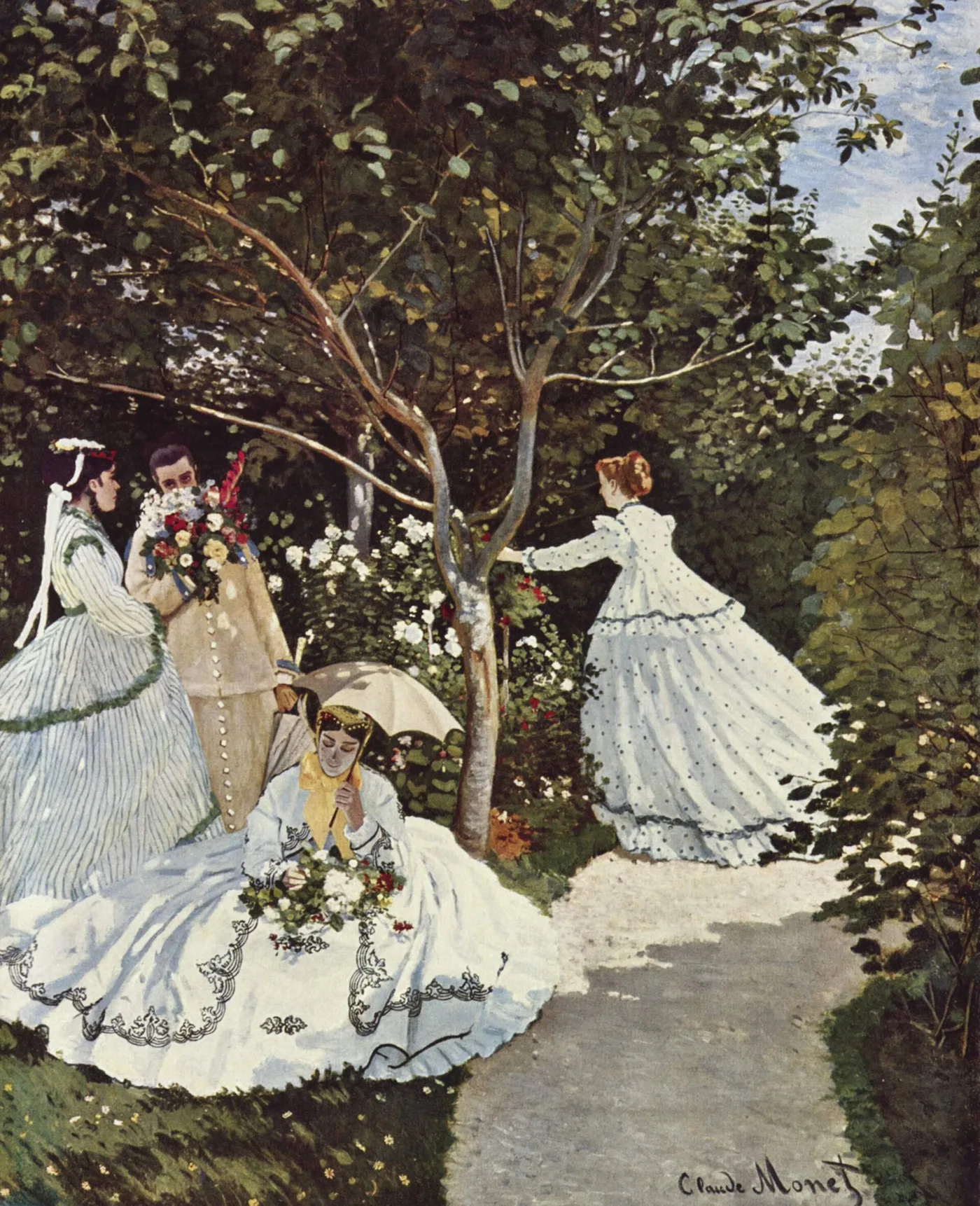
Image: Musée d'Orsay, via Wikimedia Commons.
- Date
- About 1866 (completed early 1867)
- Medium
- Oil on canvas
- Dimensions
- 255 x 205 cm
- Location
- The garden of a house Monet rented at Ville-d'Avray, near Sèvres, west of Paris; Camille Doncieux posed for the figures
- Collection
- Musée d'Orsay, Paris, RF 2773; bought from Claude Monet by the French state, 1921
- Also known as
- Femmes au jardin; Women in the Garden (1866); Femmes au jardin, à Ville d'Avray
What the painting shows
Four young women in wide summer dresses of the mid-1860s spend an afternoon in a garden. One sits on the grass in the foreground under a parasol, her skirt spread around her. Two stand together at left, one holding a bunch of flowers and lifting it to her face. A fourth, at right, reaches toward a bush, half turned away. A tree trunk rises through the center, and a sunlit path curves along the bottom of the picture.
The real subject is the light. Sun falls through the leaves onto the path and the dresses, and Monet paints the white fabric differently depending on whether it is in sun or shade, with blues and greens in the shadows. The faces are barely described, partly hidden by the parasol, the flowers and the angle of the heads. The French Wikipedia article notes that this gives the scene a slightly mysterious quality: it is a picture about a moment of light, not about who these women are.
Painting a huge canvas outdoors
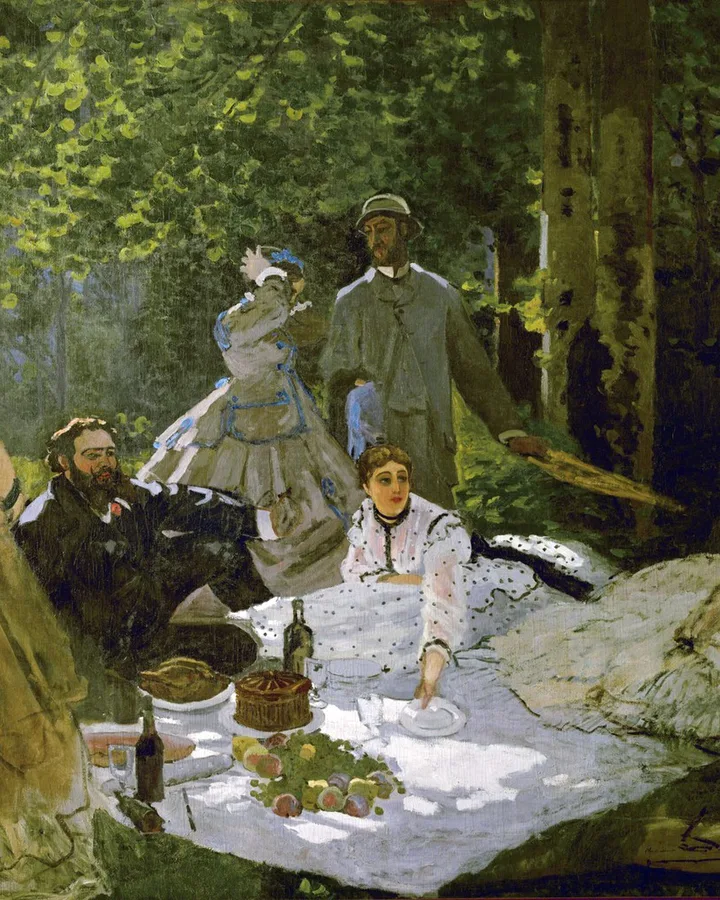
In spring 1866 Monet rented a small house near the railway station at Ville-d'Avray, west of Paris, and began this canvas in its garden. The French national collections database gives the place of execution as Sèvres, the neighboring town. The canvas is enormous for an outdoor painting, 255 by 205 centimeters, close in size to his unfinished Luncheon on the Grass of the year before.
Monet wanted to paint the whole picture in front of the subject so that the light would be true. To reach the upper part of the canvas without changing his viewpoint, he dug a trench in the garden and lowered the canvas into it, so that he could work on the top half from where he stood.
His companion Camille Doncieux, whom he later married, posed for the figures. Monet also used fashion illustrations from magazines to get the dresses right. He took the canvas with him to Normandy in the summer of 1866 and finished it after returning to Paris early in 1867.
Rejected by the Salon
Monet submitted Women in the Garden to the Salon of 1867, the official exhibition in Paris, and the jury rejected it. That year's jury was considered especially strict. Wikipedia reports that one juror complained that too many young painters were following this abominable direction, and that the picture was faulted for the weakness of its subject and narrative. There is no story here, only women in a garden in the sun.
The rejection was a serious blow, because Monet had almost no money. His friend and fellow painter Frédéric Bazille, whose own work had also been turned down, bought the painting to help him. According to the Fondation Napoléon and the French Wikipedia, the price was 2,500 francs, paid in monthly installments of 50 francs. Bazille kept the picture with his family in Montpellier. Monet and other rejected artists also signed a petition asking for a new Salon des Refusés, which was not granted.
From Bazille to Manet and back to Monet
Frédéric Bazille was killed in the Franco-Prussian War in 1870. In 1876 his father, Gaston Bazille, exchanged Women in the Garden with Édouard Manet for a portrait of his son painted by Renoir, Frédéric Bazille at His Easel, which Manet owned. The French national collections record states that Manet then returned the painting to Monet, after a falling-out between the two painters.
Monet kept it for the rest of his career. In 1921, when he was about eighty and living at Giverny, the French state bought it from him for the Musée du Luxembourg in Paris. The Fondation Napoléon gives the price as 200,000 francs, a striking contrast with the 2,500 francs Bazille had paid more than fifty years earlier. The painting later moved to the Louvre and, in 1986, to the new Musée d'Orsay. The museum reports that it was recently restored at the C2RMF, the French national conservation laboratory.
What to look for
Look at the shadows on the white dresses. The seated woman's skirt, in the shade of her parasol, is painted largely in pale blues and greens, while the sunlit parts are thick, bright white. That contrast was the main problem Monet set himself, and it is the feature the Musée d'Orsay singles out in the painting.
Then look at the path at the bottom. Patches of sunlight and leaf shadow alternate across it, painted as flat shapes of light and dark rather than as gradual modeling.
You may also notice that the figures do not quite seem to share the same space. They are arranged around the tree almost like separate studies placed side by side, and none of them looks at another. Some critics, such as Christoph Heinrich, have seen this as a weakness. Others see it as the cost of Monet's real aim, which was to capture outdoor light on a scale normally reserved for history paintings.
Frequently asked questions
Where is Women in the Garden by Monet?
It is in the Musée d'Orsay in Paris, inventory number RF 2773. The French state bought it from Monet in 1921 for the Musée du Luxembourg, and it was transferred to the Musée d'Orsay in 1986.
Who posed for Women in the Garden?
Camille Doncieux, Monet's companion and later his wife, posed for the figures. Monet also used fashion magazine illustrations for the dresses.
Why did Monet dig a trench to paint Women in the Garden?
The canvas is about 2.5 meters tall. Monet wanted to paint it entirely outdoors from one fixed viewpoint, so he lowered the canvas into a trench to reach the upper part instead of moving his position.
Why was Women in the Garden rejected by the Salon?
The jury of the 1867 Salon turned it down. It was criticized for having no real subject or narrative, and its sketchy, sunlit handling went against academic expectations for a canvas of that size.