Woman with a Parasol - Madame Monet and Her Son (1875)
Camille Monet stands on a grassy rise against a bright, windy sky, holding a green parasol, while the couple's son Jean looks out from behind the slope. Painted outdoors at Argenteuil in 1875, it is one of Monet's best-known figure paintings and hangs in the National Gallery of Art in Washington.
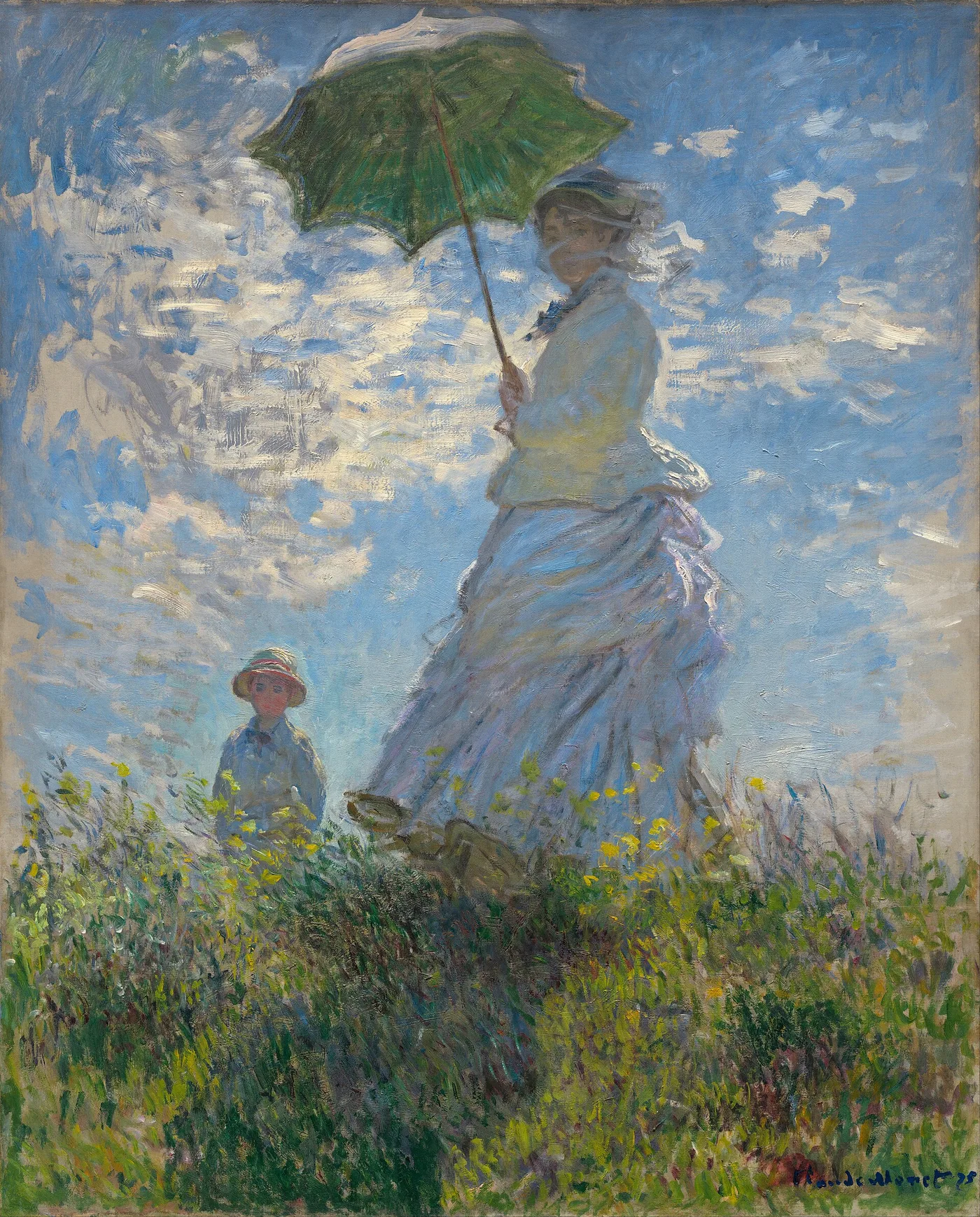
Image: Wikimedia Commons.
- Date
- 1875 (signed lower right "Claude Monet 75")
- Medium
- Oil on canvas
- Dimensions
- 100 x 81 cm (39 3/8 x 31 7/8 in.)
- Location
- Painted outdoors at Argenteuil, near Paris; the sitters are Camille Monet and Jean Monet
- Collection
- National Gallery of Art, Washington, Collection of Mr. and Mrs. Paul Mellon (1983.1.29)
- Also known as
- Woman with a Parasol; The Stroll; La Promenade; La Femme à l'ombrelle; Madame Monet and Her Son
What the painting shows
Monet's wife Camille stands on a small hill, seen from below, so that she is silhouetted against a sky full of moving white cloud. She holds a parasol tilted against the sun, and the wind pulls at her veil and the skirt of her white dress. A little behind her, cut off at the waist by the rise in the ground, stands their son Jean, looking toward the viewer.
The National Gallery of Art describes the canvas as a record of a single moment. Monet sketched the sky in quick, chaotic strokes of blue and gray and left some areas of canvas uncovered. The grass is painted more densely, in short touches of green, blue and brown, with small dabs of yellow for buttercups. That yellow is reflected on Camille's sleeve. The brightest passages are the thick slashes of white on the back of her skirt and jacket, where the light catches the fabric. Faces are barely described; Camille's features are blurred by the veil.
How and where it was made
The Monets lived at Argenteuil, a small town on the Seine northwest of Paris, for much of the 1870s, and Monet painted the house, garden and surrounding fields many times. Woman with a Parasol was painted there in the summer of 1875. The National Gallery of Art states that it was completed in a single outdoor session, and the loose handling supports that account: there is little sign of reworking, and the paint was laid down quickly.
At 100 by 81 centimeters it is a substantial canvas for a work painted on the spot. The art historian Mary Tompkins Lewis has called it the largest and most imposing of Monet's paintings of the decade. Even so, it is not a formal portrait. The pose suggests that mother and son have paused for a moment during a walk, and Monet treats them with the same quick touch he uses for the clouds and the grass. Jean was about seven.
First exhibition and early owners
Monet showed the painting in April 1876 at the second Impressionist exhibition, held at the gallery of the dealer Paul Durand-Ruel in Paris. It was listed in the catalogue as number 161, under the simple title Promenade, meaning a walk or stroll. Monet sent eighteen works to that show.
In 1876 the picture went to Dr. Georges de Bellio, a homeopathic physician in Paris who collected Impressionist painting and often helped Monet with money, sometimes being paid in pictures. After de Bellio's death in 1894 it passed to his daughter Victorine and her husband, Ernest Donop de Monchy, the same family that later gave Impression, Sunrise to the Musée Marmottan. By 1924 the painting belonged to Georges Menier, a Paris collector. It was sold at the Menier sale in Paris on 15 June 1965 and bought for Paul Mellon, who gave it to the National Gallery of Art in 1983.
Why it became famous
Woman with a Parasol has become one of the most recognized images of Impressionism because it shows, in one canvas, what the painters were trying to do outdoors. It is a scene of ordinary modern life, a family on a walk, painted in front of the subject in a few hours, and its real subject is light and weather. The wind in the veil and the shadows that turn the white dress blue and green are as important as the people.
The picture also mattered to other artists. The American painter John Singer Sargent saw it at the 1876 exhibition, and it is often cited as an influence on his later outdoor figure paintings, such as Two Girls with Parasols at Fladbury (1889).
Monet himself returned to the theme more than ten years later. In 1886, at Giverny, he painted two canvases of a woman with a parasol on a hillside, using as his model Suzanne Hoschedé, the daughter of Alice Hoschedé, who later became his second wife. Both are now in the Musée d'Orsay in Paris, and they are often confused with the 1875 painting in Washington.
What to look for
Start with the viewpoint. Monet places the horizon very low, so Camille rises above the viewer and fills the sky. The parasol almost touches the top edge of the canvas, which makes the figure feel close and tall.
Then look at the white dress. Very little of it is pure white. Where it is in the shade of the parasol it is painted in blues and greens, and on the side facing the field it picks up yellow from the flowers. Only the narrow strip on the back, catching the full sun, is laid on in thick white.
Finally, compare the different speeds of the brushwork. The sky is scrubbed in with long, open strokes, some of which leave the canvas showing through. The grass is built from short, dense touches. The figures fall in between. The NGA describes the work as a celebration of color and light, and the variety of handling is how Monet achieves it.
Frequently asked questions
Where is Woman with a Parasol by Monet?
The 1875 painting of Camille and Jean Monet is in the National Gallery of Art in Washington, D.C., accession number 1983.1.29, a gift of Paul Mellon. Two later versions from 1886, showing Suzanne Hoschedé, are in the Musée d'Orsay in Paris.
Who is the woman in Woman with a Parasol?
She is Camille Monet, the artist's first wife. The boy behind her is their son Jean. Jean was about seven years old at the time.
How long did it take Monet to paint Woman with a Parasol?
The National Gallery of Art says it was completed in a single outdoor session, which means a matter of hours. The quick, open brushwork and areas of bare canvas in the sky reflect that speed.
How big is Woman with a Parasol?
The canvas measures 100 x 81 cm, or 39 3/8 x 31 7/8 inches, according to the National Gallery of Art.