The Magpie (1868-1869)
A single black magpie perches on a wooden gate in a snow-covered field, while low winter sun throws blue-violet shadows across the snow. Painted near Étretat in the winter of 1868-69 and rejected by the Salon of 1869, The Magpie is Monet's largest snow scene and one of the best-loved paintings in the Musée d'Orsay.
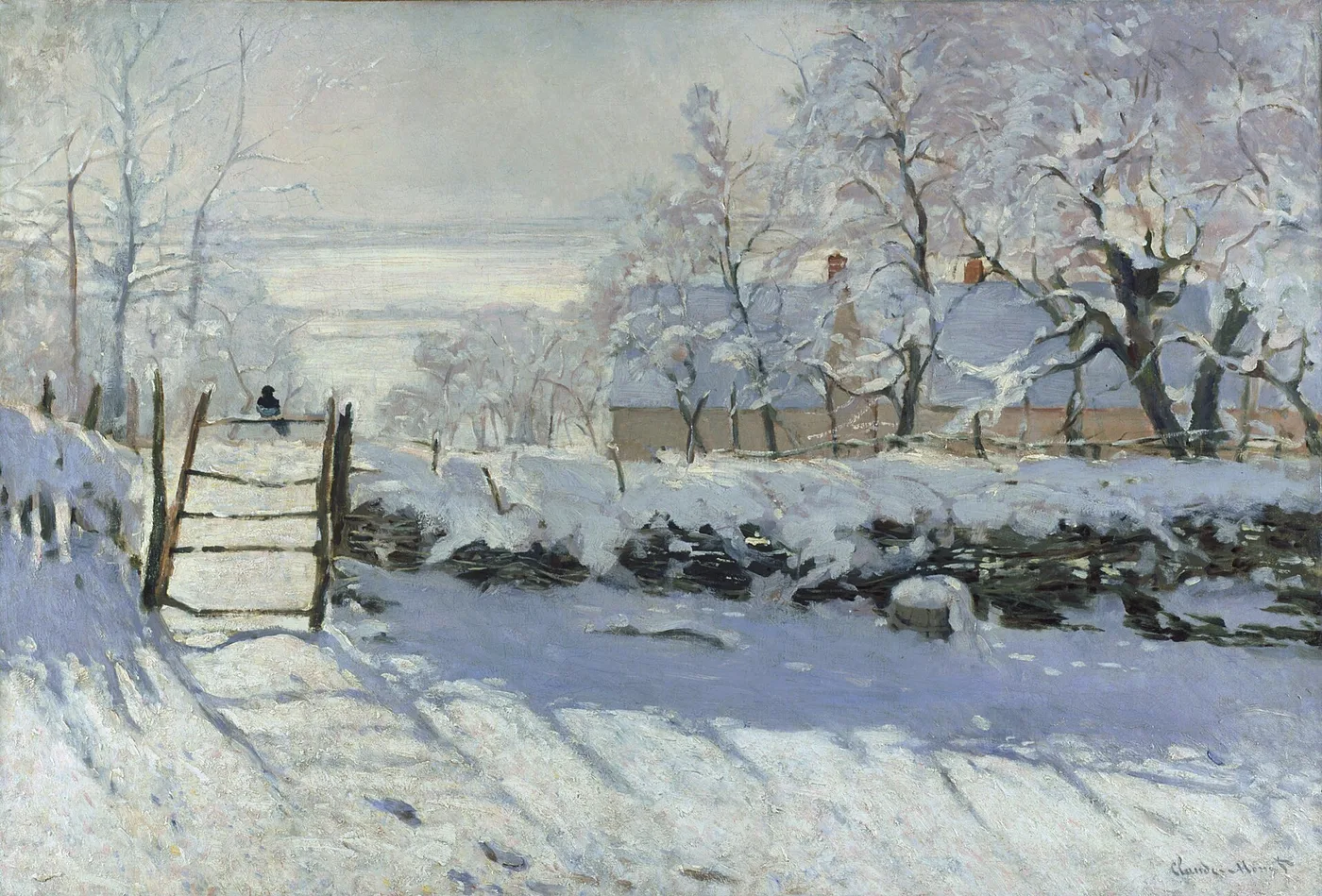
Image: Musée d'Orsay, via Wikimedia Commons.
- Date
- Between 1868 and 1869 (painted at Étretat in the winter of 1868-69)
- Medium
- Oil on canvas
- Dimensions
- 89 x 130 cm
- Location
- The countryside near Étretat, on the Normandy coast; the exact spot is not known
- Collection
- Musée d'Orsay, Paris, RF 1984 164; purchased 1984
- Also known as
- La Pie; The Magpie (Monet); Monet magpie in snow
What the painting shows
The scene is a farmyard edge in deep snow on a sunny winter day. A wattle fence, woven from branches and heavy with snow, runs across the picture from left to right. In it is a small wooden gate, and on top of the gate sits a single magpie, black and white, the only living thing in sight. Behind the fence are snow-laden trees and the roof of a farmhouse. In the foreground, the fence and gate cast long shadows across the snow toward the viewer.
There are no people. The Musée d'Orsay compares the bird to a note on a musical staff, a single dark accent set against the horizontal lines of the fence. Almost everything else in the painting is white, cream, pale yellow, blue and lilac. The sky is a soft, warm haze, and the sunlight on the snow is painted in thick, creamy strokes. The shadows are not gray or black but blue, which is the feature most writers single out.
A winter at Étretat
Monet spent the winter of 1868-69 at Étretat, a fishing village on the Normandy coast known for its chalk cliffs. His patron Louis Joachim Gaudibert helped him rent a house there for Camille Doncieux and their son Jean. In the same period Monet painted The Luncheon, a domestic scene with Camille and Jean.
The Musée d'Orsay states that the picture was painted on the spot in the countryside near Étretat. Monet made around 140 winter landscapes over his career, and The Magpie is the largest of them.
The exact location has never been identified. One scholar, Ralph T. Coe, proposed the Saint-Siméon farm near Honfleur, but the museum's record places the painting at Étretat. The canvas is signed "Claude Monet" at lower right. At 89 by 130 centimeters, it is a large picture to have been made on the spot in winter.
Rejected by the Salon of 1869
Monet submitted The Magpie to the official Paris Salon of 1869, and the jury rejected it, along with another of his paintings. The Musée d'Orsay explains the decision by the novelty and daring of the approach, which was more about perception than description.
To understand why, it helps to remember what Salon audiences were used to. Respectable landscapes were often dark and carefully finished, and snow, when it was painted at all, tended to be a backdrop for dramatic subjects. Gustave Courbet, the leading realist painter, had recently shown large snow scenes with hunting themes. Monet kept the snow but dropped the drama, choosing a small bird on a gate.
The critic Félix Fénéon later recalled how strange the canvas looked to the public, which was used to the dark, tarry tones of academic painting and was startled by its paleness. The rejection also came five years before the first Impressionist exhibition, at a time when Monet was still trying to win acceptance through the Salon.
From private collections to the Musée d'Orsay
The Magpie remained in private hands for more than a century. The Musée d'Orsay lists its owners as Thor Carlander in Paris, then the Durand-Ruel collection, and from about 1957 the Guerlain collection in Paris. It was shown in several major Monet exhibitions in the 1950s, including at the Tate Gallery in London in 1957.
In 1984 the French national museums bought the painting for the Musée d'Orsay, which opened in 1986. It has since become one of the museum's most popular works and has traveled widely, including to the 1994-95 exhibition on the origins of Impressionism at the Grand Palais and the Metropolitan Museum of Art, and the 1998-99 exhibition Impressionists in Winter at the Phillips Collection in Washington. It is not always on display in Paris, so check the museum's website before a visit.
What to look for
Look closely at the shadows of the fence and gate. Instead of painting them gray, Monet used blues and violets, the colors that snow actually reflects from a clear sky. The Magpie is one of the earliest examples of his colored shadows, an idea that became central to Impressionist painting. Against these cool shadows, the sunlit snow is warm, tinged with yellow and cream.
Notice how little contrast there is overall. Apart from the magpie, the fence posts and a few dark branches, the whole canvas sits in a narrow range of very light tones. That is what made it look so pale and unfinished to viewers in 1869.
Finally, find the bird. It is small, placed slightly left of center, and it is the darkest and most precise mark in the painting. Cover it with your thumb and the picture loses its focus. The curator Lynn Orr called the painting a virtuoso color performance, and the magpie is the single note that holds it together.
Frequently asked questions
Where is The Magpie by Monet?
It is in the Musée d'Orsay in Paris, inventory number RF 1984 164. The French national museums bought it in 1984 from a private collection.
Where did Monet paint The Magpie?
In the countryside near Étretat on the Normandy coast, during the winter of 1868-69. The exact spot has not been identified.
Why are the shadows blue in The Magpie?
Monet painted the shadows on the snow in blue and violet because shaded snow reflects the color of the clear sky. It is one of the earliest examples of the colored shadows that became a hallmark of Impressionism.
Why was The Magpie rejected by the Salon?
The jury of the 1869 Salon turned it down. Its pale, light-filled colors and loose handling broke with the dark, finished style expected of landscape painting at the time.